
 Design Creative Lab
Your company's Christmas card is one of the few pieces your clients receive without you selling them anything. That's why it shows so much when it's well made, and when it looks like a template downloaded at the last minute.
I've been designing brands since 1994, and every December I see the same thing: companies that plan their greeting ahead come across as warmer and more professional than those that send any image with "Happy Holidays". Here's what a business Christmas card should include, how to make one step by step and which messages actually work with clients.
What is a business Christmas card for?
A business Christmas card is a way to thank your clients, suppliers and team and close the year with them, while reminding them who you are without sounding like an ad. Done well, it:
- Strengthens the relationship: clients feel you thought of them.
- Keeps your brand present in a month when everyone competes for attention.
- Opens the door for January: it's easier to pick up a conversation after a thoughtful gesture.
What should a business Christmas card include?
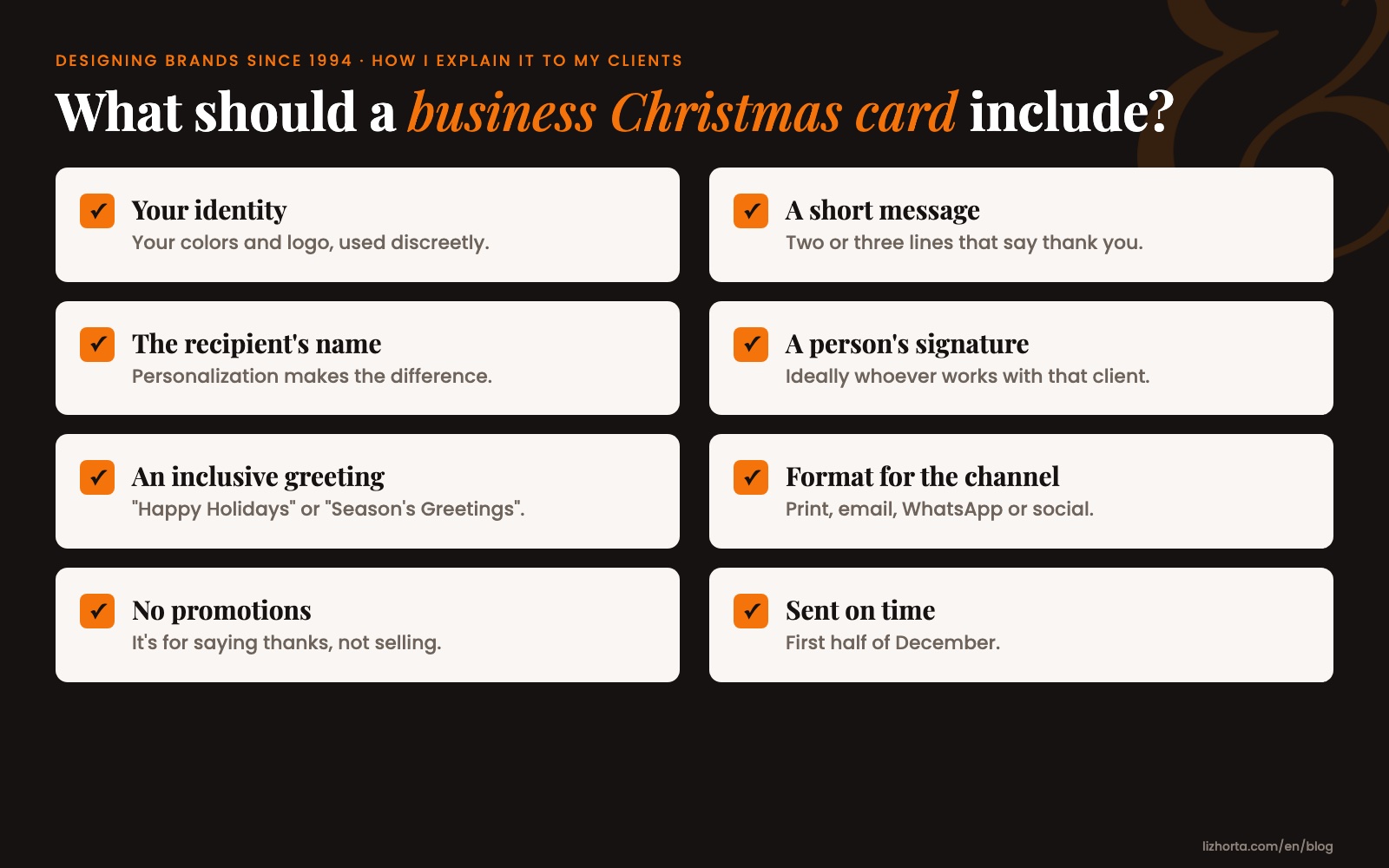
- Your identity, not just holiday motifs. Your colors and logo, used discreetly, so people recognize it's yours at a glance.
- A short, sincere message. Two or three lines that say thank you in a specific way.
- The recipient's name, whenever possible. Personalization makes the difference.
- A person's signature, not just "Management". Even better if it's signed by whoever works with that client.
- An inclusive greeting. "Happy Holidays" or "Season's Greetings" works for clients of different beliefs.
- A format designed for where it will be seen: print, email, WhatsApp or social media.
Formal or friendly Christmas card?
It depends on your brand and who receives it. A law firm, a construction company or a financial institution usually calls for a formal tone: elegant type, few elements and a sober message. A school, a restaurant or a consumer brand can be warmer, with illustration, humor or a team photo.
My rule is simple: the card should sound like your company the rest of the year. If your emails are casual, so is the card; if your brand is serious, don't turn it into a meme.
How to make a business Christmas card step by step
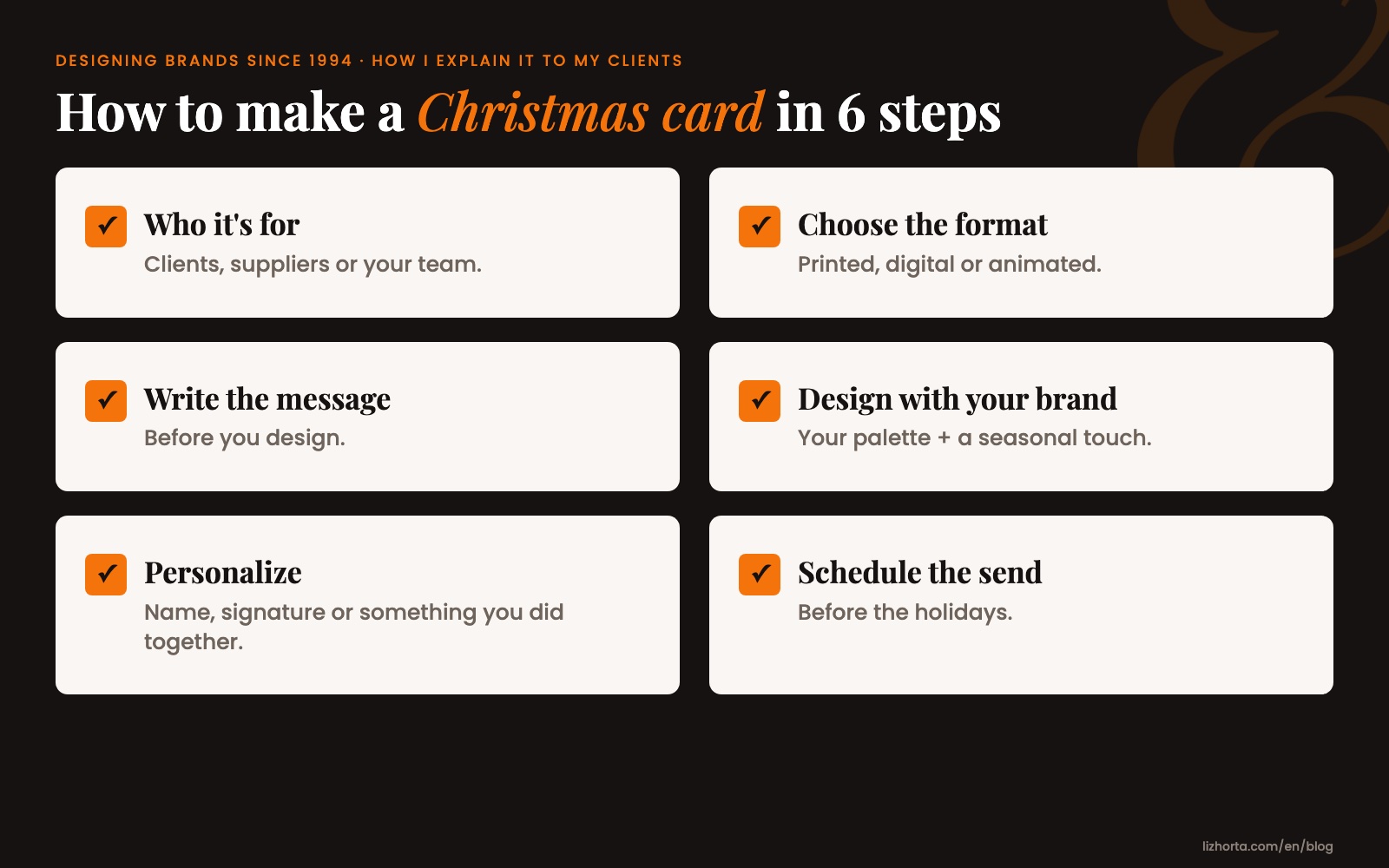
- Decide who it's for. Clients, suppliers, your team or all three. You can have a version for each group.
- Choose the format. Printed (with envelope and delivery time), digital for email, a vertical version for WhatsApp or a short animation.
- Write the message before designing. The text defines how much space you need.
- Design with your identity. Start from your palette and typefaces and add one or two seasonal elements.
- Personalize. The client's name, the signature of whoever looks after them or a line about something you did together this year.
- Schedule the send. Ideally in the first half of December, before your clients go on vacation.
What to write in a business Christmas card to clients
Some ideas you can adapt:
- Formal: "Thank you for the trust you placed in us this year. We wish you happy holidays and a prosperous 2027."
- Friendly: "Thanks for choosing us in 2026. May these holidays bring you rest and good company."
- With something specific: "It was a pleasure to be part of your new brand launch. Thank you for letting us join you."
- For suppliers: "Thank you for teaming up with us all year. Happy holidays to you and your family."
- For your team: "What we achieved this year was thanks to each of you. Enjoy the holidays."
Avoid generic lines that could come from any company, and leave promotions out: the card is for saying thanks, not for selling.
Printed or digital?
A printed card gets kept, placed on a desk and feels like a gift; it's worth it for key clients and requires planning design, printing and delivery weeks ahead. A digital card reaches everyone at once, and one design can be adapted to email, WhatsApp and social media. Many companies combine both: printed for their most important clients and digital for everyone else.
Which famous Christmas cards made history?
- Henry Cole, 1843. He commissioned painter John Callcott Horsley to design the first modern Christmas card, printed in England to send to his acquaintances. Read the history of the Christmas card
- Louis Prang, 1874. His printing company began selling Christmas cards in the United States, and by the 1880s it was producing over five million a year, which is why he's called "the father of the American Christmas card". Read about Louis Prang
- Haddon Sundblom for Coca-Cola, from 1931. His Santa Claus illustrations for the brand's Christmas advertising ran for decades and set the image almost everyone recognizes today. Read about Haddon Sundblom
All three show the same thing: a well-designed greeting is remembered for years and becomes part of the brand.