
 Design Creative Lab
Doctors, accountants, architects and lawyers are rarely hired for their logo. They are hired because someone recommended their name and, before calling, looked it up on Google and LinkedIn. What people find in those two minutes decides whether they call.
I have been designing brands since 1994 and have worked with professionals and firms in many fields: health, law, engineering, consulting and services. This is the order I recommend to start your personal brand without putting your professional reputation at risk.
What is a professional's personal brand?
It is the reputation your name carries: what you are an expert in, how you work and why someone would trust you with something important, whether that is their health, their finances, their home, a project or a legal matter. In trust-based professions, people hire individuals before companies, so your name is your main asset.
A personal brand does not replace the brand of your practice, office or firm: it supports it. A team with visible professionals who are known in their specialty conveys more strength than a logo alone.
Why does a professional need a personal brand?
- Because people look you up before hiring you. A referral almost always ends in a search for your name.
- Because a specialty sells better than being a generalist. "Sports nutritionist" or "steel structures engineer" is memorable; "nutritionist" or "engineer" on its own is not.
- Because trust is built before the first contact. If they have already read how you explain a topic, they arrive at the first meeting halfway convinced.
- Because artificial intelligence is looking for you too. ChatGPT, Gemini and Google's AI summaries recommend professionals with a name, a clear specialty and published content.
Where do I start my personal brand as a professional?
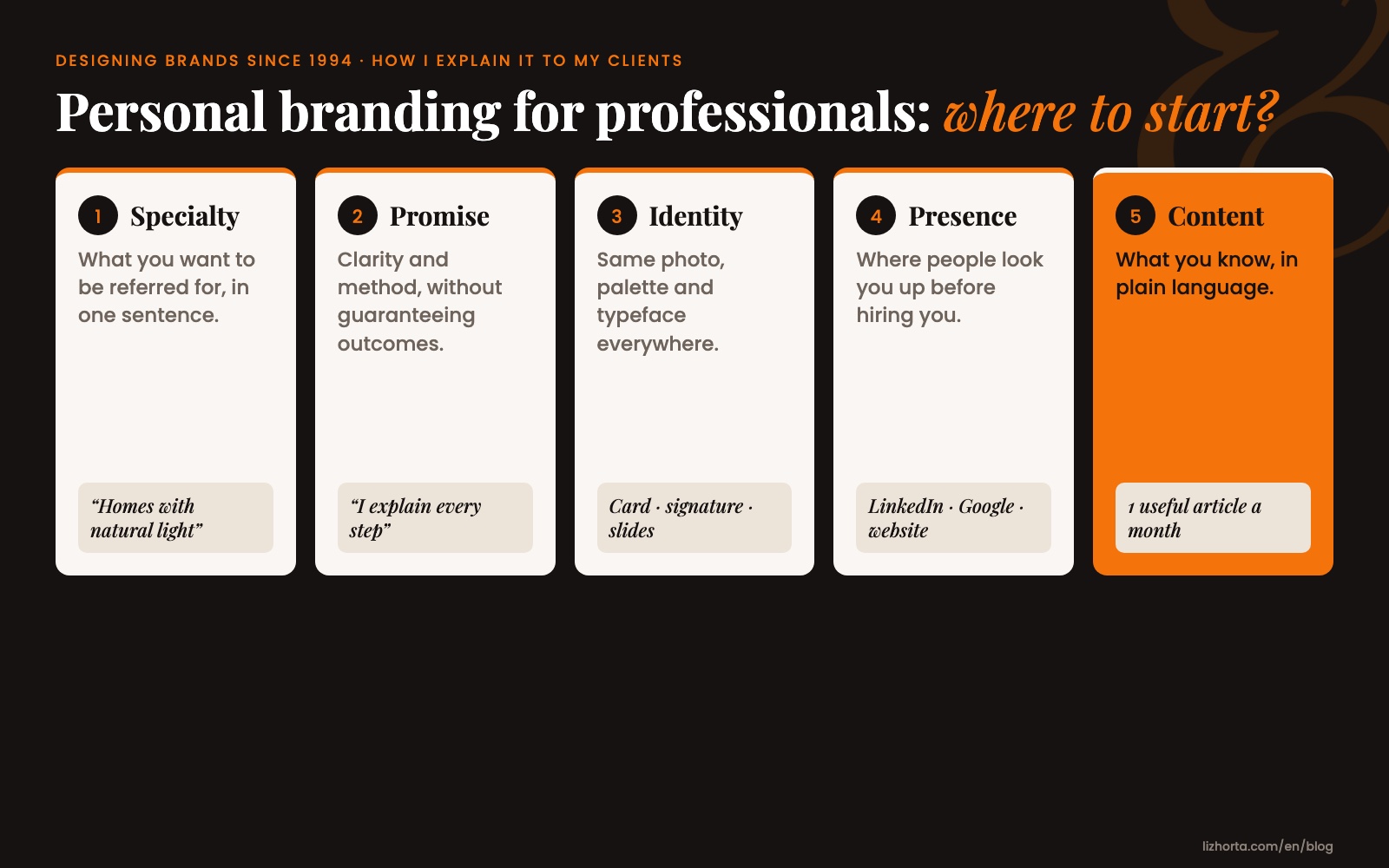
- Define your specialty in one sentence. Not everything you can do: what you want to be referred for. Example: "I design homes that make the most of natural light" or "I help small businesses get their taxes in order."
- Write your promise without promising outcomes. A doctor cannot guarantee a cure and a lawyer cannot guarantee a ruling, but both can promise clarity, guidance and rigor.
- Bring order to your visual identity. A good professional photo, plus one palette and one typeface used the same way on your card, email signature and presentations.
- Show up where people search for you. A complete LinkedIn profile, a Google Business Profile if you see clients at a fixed location, and a page with your name explaining what you do.
- Publish what you know, in plain language. One article or post a month that answers a real client or patient question is worth more than ten motivational quotes.
For the full foundation (purpose, values and value proposition), read What are the foundations of a personal brand?
What should a professional watch out for ethically?
Many professions have their own rules: lawyers, doctors and accountants, for example, follow codes of ethics and, in some cases, rules on advertising. A well-built personal brand respects them:
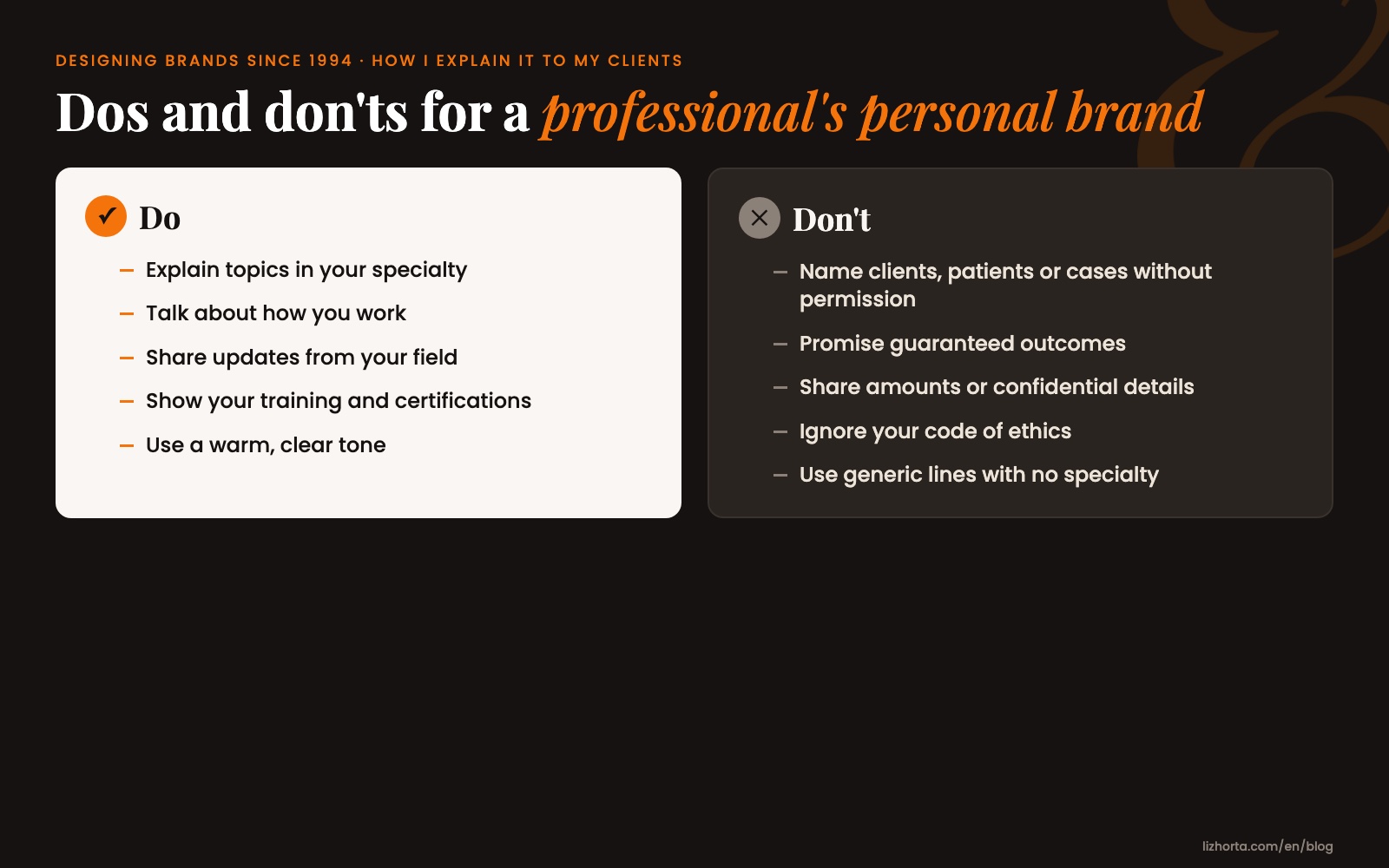
- Confidentiality. Do not mention clients, patients, cases or amounts without written permission.
- No guarantees. Avoid lines like "guaranteed results"; convey method and experience instead.
- Your code of ethics. Check what your professional association, bar or board says about advertising.
- Serious, not cold. You can be warm and clear without losing credibility.
Which social networks work for professionals?
LinkedIn is the main network for engineers, lawyers, accountants, consultants and professionals who sell to companies: that is where directors and decision-making teams are. Instagram works better for those who serve individuals (doctors, therapists, nutritionists, residential architects), and YouTube or a podcast help explain complex topics at a calm pace.
You do not need to be everywhere. Choose one main network, post consistently and use the others to repurpose.
What should a professional's LinkedIn profile include?
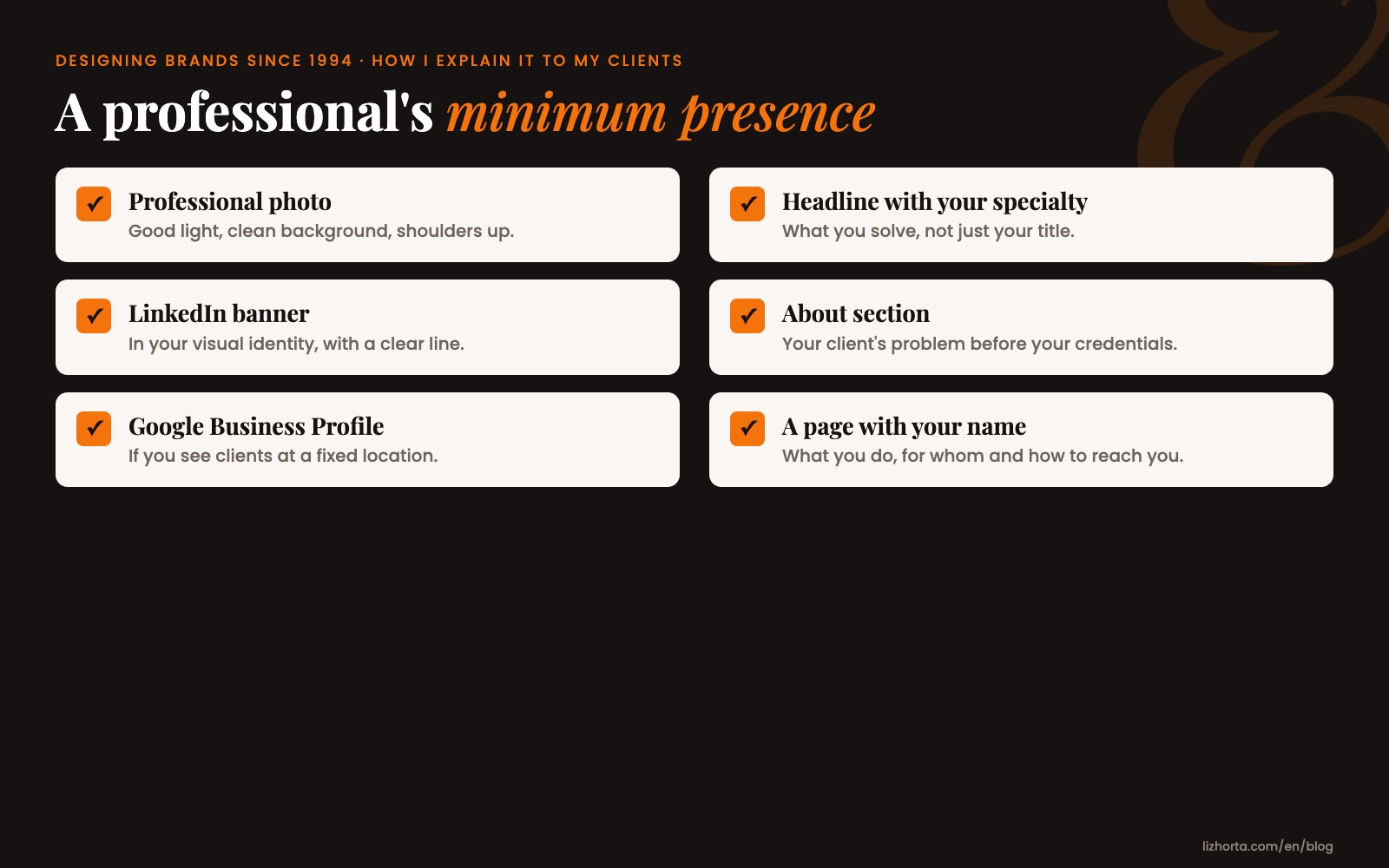
- A professional photo with good light and a clean background, shoulders up.
- A headline with your specialty, not just your job title: "Accountant · taxes for small businesses and independent professionals."
- A banner image in your visual identity with a line about what you solve.
- An About section that talks about your client's problem before your credentials.
- Featured posts: your best articles or a presentation of your services.
What are some examples of professionals with a strong personal brand?
- Ruth Bader Ginsburg. Before joining the U.S. Supreme Court, she became known for a very clear specialty: litigating gender equality cases. Her name became tied to that cause. Read her biography
- Atul Gawande. A surgeon who built his reputation by writing for the general public about medicine and patient safety. Read his biography
- Marie Kondo. She turned her way of working into a named method, something any professional can do with their own process. Read her story
Your personal brand is also visual: learn how to choose your logo's typeface in What font should you use for a logo?