
 Design Creative Lab
A good slogan fits on one line and stays in people's heads for years. It is the phrase that travels with your brand and tells customers, in a few words, what they can expect from you.
I have been designing brands since 1994. Whenever a client asks for a logo, the next question is almost always "and what line do we put next to it?". Here is how I approach it, with famous examples and a process you can follow yourself.
What is a slogan?
A slogan is a short, memorable phrase that sums up a brand's promise, personality or central idea. It goes next to the logo on ads, packaging, business cards, your website and social media.
Your logo is what people see, your name is what they call you, and your slogan is what you say about yourself in one line.
What is a business slogan for?
- It explains what the name doesn't. If your brand is your own name, the slogan says what you do or what makes you different.
- It helps people remember you. A line with rhythm gets repeated and remembered far more than a paragraph.
- It sets the tone. A law firm's slogan and a bakery's slogan shouldn't sound the same.
- It keeps you consistent. Everything you publish can grow from that same idea.
What are the characteristics of a good slogan?
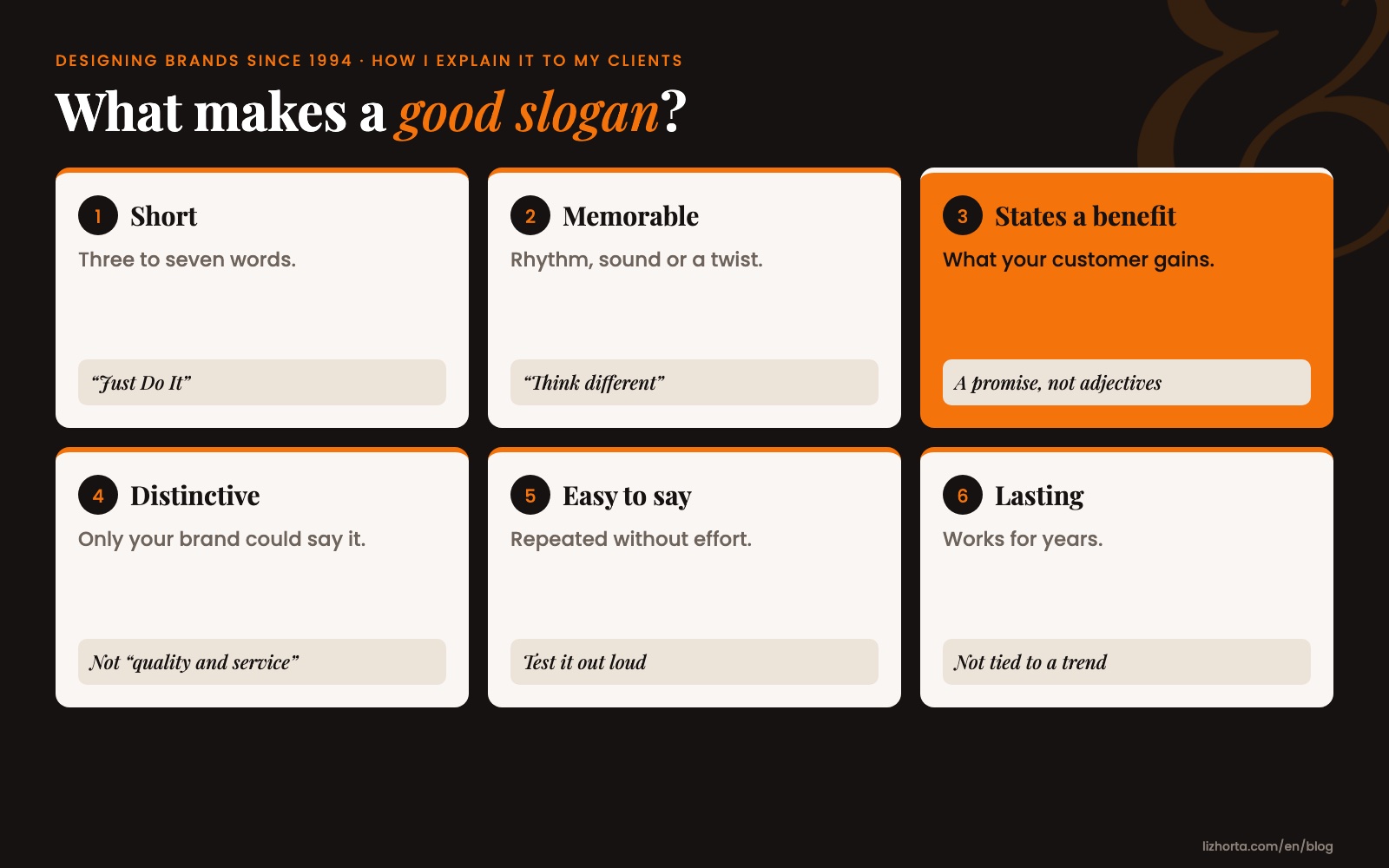
- Short. Three to seven words is usually enough.
- Memorable. It has rhythm, a repeated sound or an unexpected twist.
- States a benefit. It talks about what the customer gains, not adjectives about you.
- Distinctive. If a competitor could sign it, it isn't your slogan yet. Anyone can say "quality and service".
- Easy to say. If you stumble reading it out loud, nobody will repeat it.
- Lasting. It doesn't depend on a trend or this month's promotion.
What is the difference between a slogan, a tagline and a mission statement?
- Brand slogan or tagline: stays with the brand for years and usually sits next to the logo.
- Campaign line: belongs to one specific campaign and changes when it ends.
- Mission statement: describes the company's purpose. It is longer and mostly used internally.
Many brands use all three. The common mistake is trying to squeeze the whole mission into the slogan.
How do you write a slogan for your business, step by step?
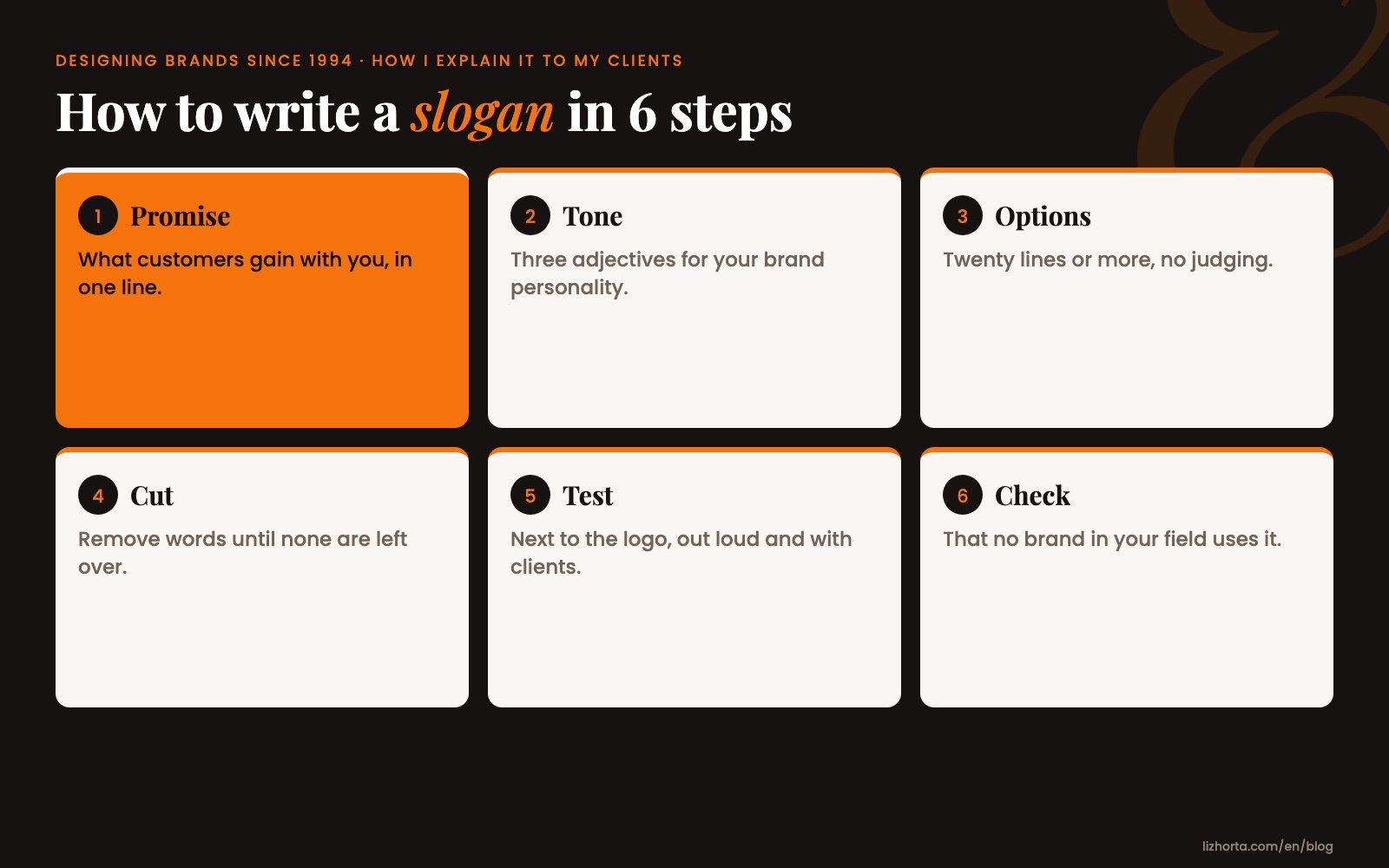
- Write your promise. What customers gain with you, in one plain sentence, even if it doesn't sound good yet.
- Define the tone. Pick three adjectives for your brand personality: warm, expert, playful, elegant…
- Generate lots of options. At least twenty lines, without judging them. Play with verbs, questions and contrasts.
- Cut. Remove words until none are left over. Articles and adjectives are usually the first to go.
- Test it next to the logo. Put it on your card, in a post and say it out loud. Ask three clients what they understand.
- Check that it's free. Search for it online and in your country's trademark database so no brand in your field already uses it.
How do you write a slogan for a personal brand?
If your brand is your name, the slogan does extra work: it says what you do and for whom. A line that combines your specialty with the result your clients want works very well.
Before writing it, it helps to be clear on your purpose and brand personality. I explain them in What Are the Foundations of a Personal Brand?
What are some famous slogan examples?
- Nike, "Just Do It". Born in 1988, it turned sport into an attitude in three words. Read the history of "Just Do It"
- Apple, "Think different". A 1997 campaign that ended up summing up the brand's personality. Read the history of "Think different"
- L'Oréal, "Because I'm worth it". Created in 1973, it puts the customer at the center of the line, not the product. Read the history of L'Oréal
All three work for the same reason: they say one idea and repeat it for years.
If you are still choosing the name, start there: What Is Brand Naming and How Do You Choose a Brand Name?