
 Design Creative Lab
When people think of safe cars, they think of Volvo. That is positioning: the place your brand holds in your customers' minds, the word they link you with even when you're not around.
I have been designing brands since 1994, and I've seen that the most beautiful logo doesn't do much if the brand isn't clear about the place it wants to hold. Here is what positioning is, the main types and how to build it step by step.
What is brand positioning?
Brand positioning is the main idea you want customers to identify you with, the one that sets you apart from competitors. It isn't what you say about your brand. It is what people understand and remember about it.
Jack Trout made the term popular in 1969. Later, with Al Ries, he turned it into the book Positioning: The Battle for Your Mind. The core idea still holds: people remember few brands per category, so you need to be the first choice for something specific.
How is positioning different from branding?
- Positioning is the strategic decision: which place you want to hold and against whom.
- Branding is everything you do to build that place: name, logo, colors, tone, experience and content.
You decide the positioning first; branding gives it shape. I go deeper into branding in What Is Branding and How Is It Different from Logo Design?
What types of brand positioning are there?
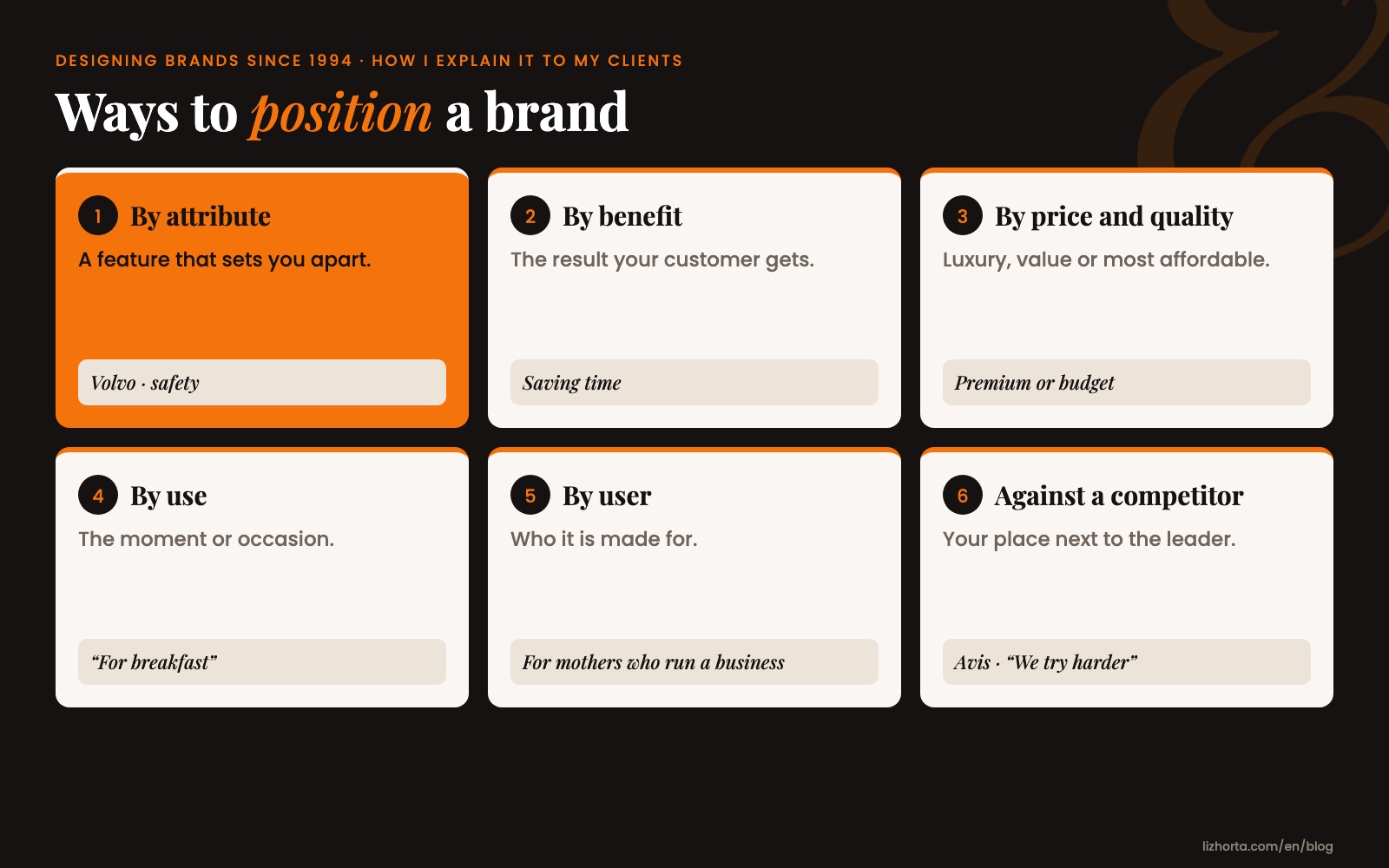
- By attribute. A feature that sets you apart. Example: Volvo and safety.
- By benefit. The result your customer gets: saving time, looking good, peace of mind.
- By price and quality. Luxury, best value or the most affordable option.
- By use or occasion. The moment your product or service is used.
- By user. Who your brand is made for, such as independent professionals or mothers who run a business.
- Against a competitor. Your place relative to the market leader. Example: Avis and "We try harder".
Most brands combine two types. The mistake is trying to cover them all.
How do you build your brand positioning, step by step?
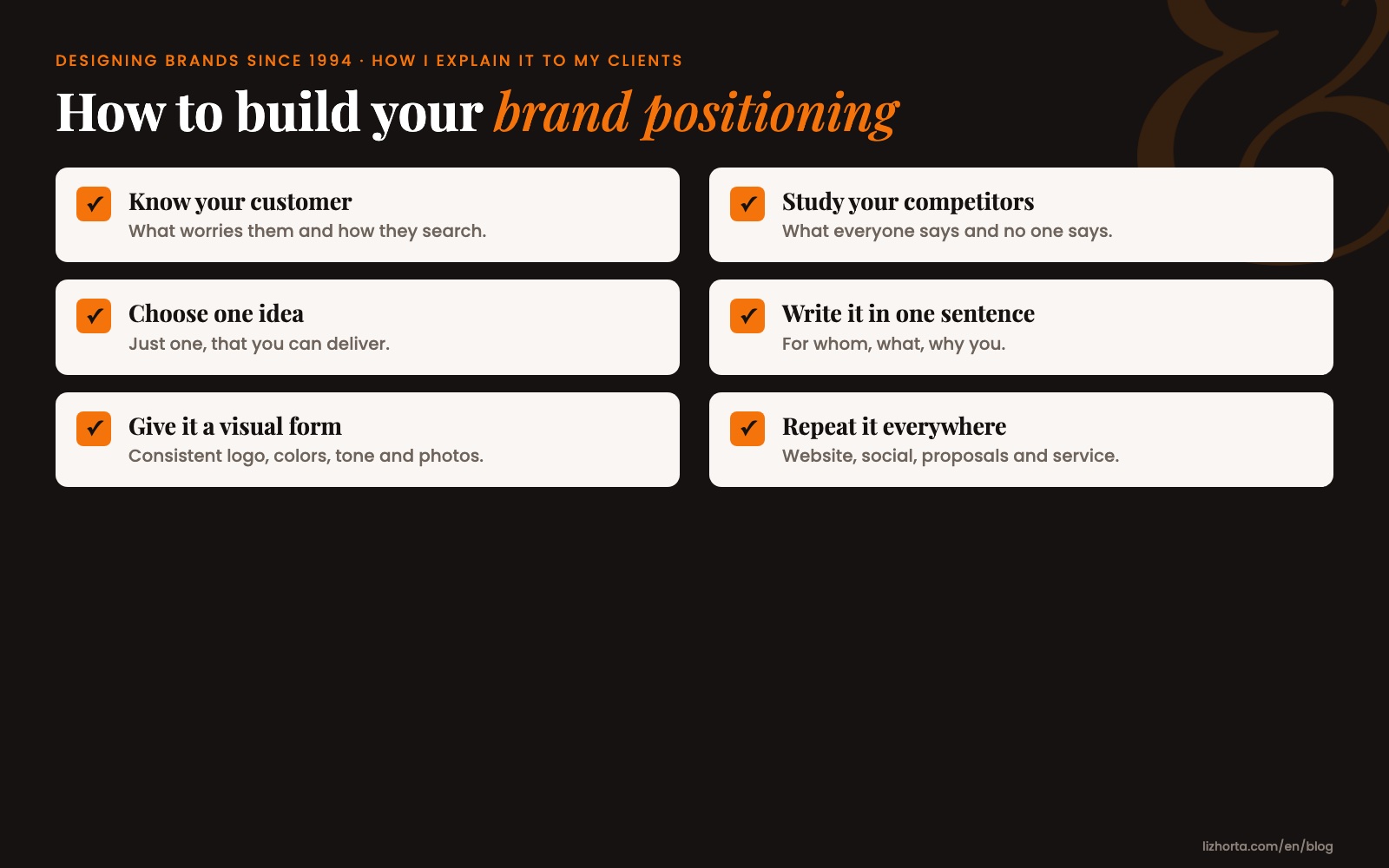
- Know your customer. What worries them, which words they use and where they search before hiring.
- Study your competitors. Write down what everyone says and look for what no one is saying.
- Choose one idea. It must matter to your customer, be different from competitors and be something you can always deliver.
- Write it in one sentence. Use the formula below.
- Give it visual and verbal form. Logo, colors, typeface, photos and tone should all tell the same idea.
- Repeat it everywhere. Website, social media, proposals, packaging and the way you serve clients. Positioning is built through consistency.
How do you write a positioning statement?
A simple formula I use with clients:
For [your ideal customer] who [their need or problem], [your brand] is [your category] that [your main benefit], because [the reason to believe you].
It isn't meant to be published as is. It's an internal compass: your slogan, website copy and content ideas come from it. To turn it into a public line, see What Is a Slogan and How Do You Write One for Your Business?
How do you position a brand on social media?
Social media doesn't create positioning; it repeats it. It works when:
- Your profile says in one line what you do and for whom.
- Your posts revolve around three or four themes tied to your central idea.
- Your visual identity is recognizable without seeing the name.
- You reply and serve clients in the same tone you promise.
If your brand is your name, the process is very similar. I explain it in How to Build a Personal Brand Step by Step
What are some brand positioning examples?
- Volvo. It has built its brand around safety for decades, from the three-point seat belt to today. Read the history of Volvo
- Avis. In 1962 it adopted "We try harder" and turned being number two in car rental into a reason to choose it. Read the history of Avis
- The positioning concept. The origin of the term and the Ries and Trout book. Read "Positioning" on Wikipedia)