
 Design Creative Lab
Many companies come to me saying "we want a rebrand" when what they really need is an update to their logo. And others ask for "just a new logo" when their business has changed so much that the whole brand has been left behind. Knowing which one is your case saves you time and money.
I have been designing brands since 1994, and this is how I explain it before starting any project.
What is rebranding?
Rebranding is the strategic renewal of a brand: you review what the company is today, who it speaks to and how it wants to be remembered, and from there you transform its identity. It can include a new logo, different colors, a new way of speaking, a new positioning and, in the biggest cases, even a new name.
The key word is strategic: a rebrand starts with a change in the business, and design is the way to make that change visible.
What is the difference between branding and rebranding?
- Branding: building a brand from scratch. It is what you do when your business is born.
- Rebranding: renewing a brand that already exists and already has history, clients and recognition.
That is why rebranding calls for extra care: you have to decide what to keep so your clients keep recognizing you. If you want to review everything branding covers, I explain it in What Is Branding, and How Is It Different from a Logo?
What is the difference between a rebrand and a brand refresh?
Think of it as a scale:
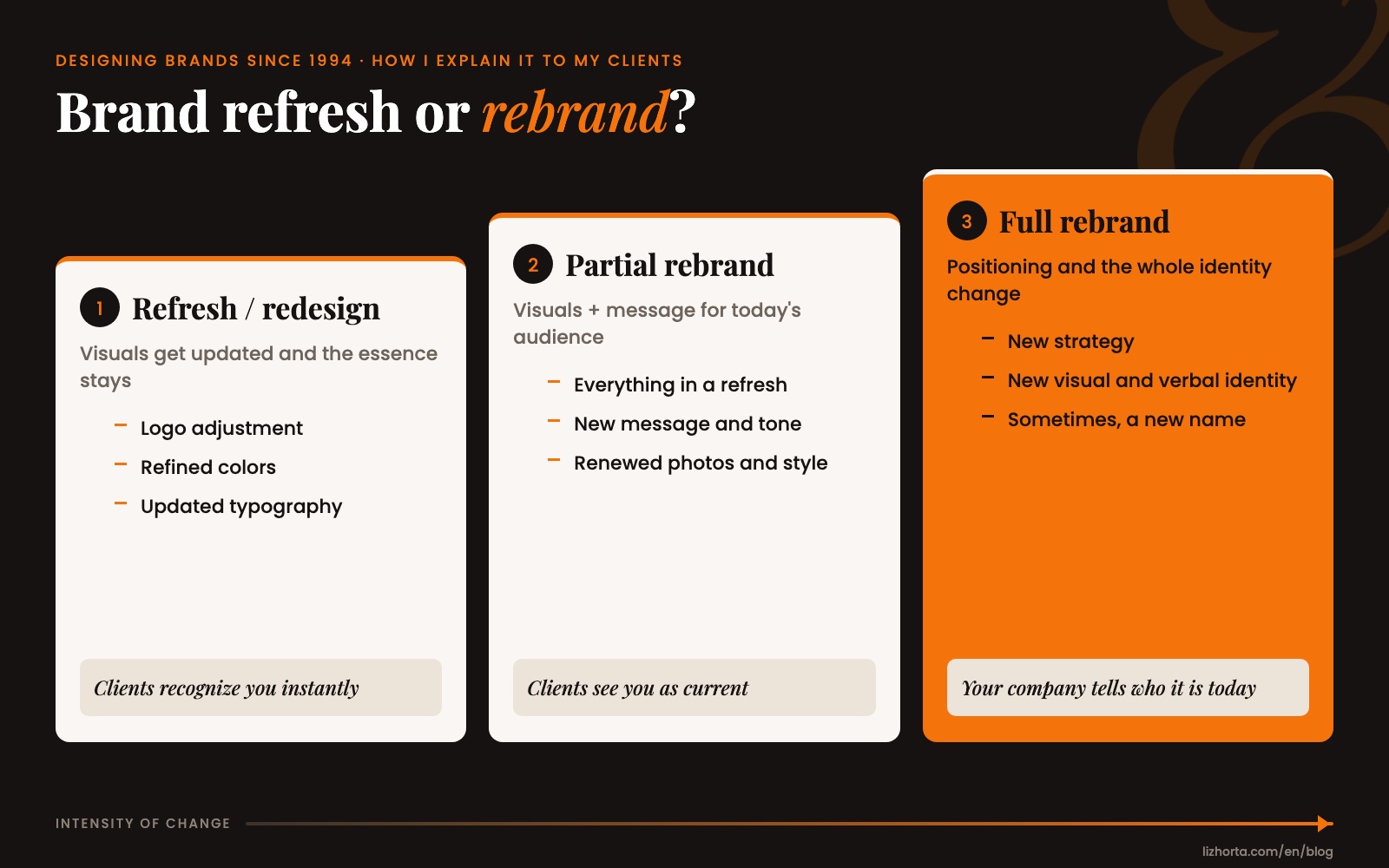
- Brand refresh or redesign: the visuals get updated and the essence stays. The logo is adjusted, the colors refined, the typography updated. Your clients recognize you instantly.
- Partial rebrand: besides the visuals, the message and tone are adjusted to speak better to your current audience.
- Full rebrand: the positioning and the whole identity change; sometimes the name too. It is for when the company has transformed on the inside.
Most of the companies I work with need level 1 or 2. A full rebrand is for big moments.
When should you rebrand your business?
These are the signs I see most often:
- Your business grew and the brand stayed in another stage. You started with one service and today you offer five.
- You speak to a new audience. Your ideal clients today are different from ten years ago.
- There was a merger, an acquisition or a change of partners. Two brands become one.
- Your logo looks dated on screen. It gets lost on a phone or a social media profile.
- Clients mix you up with your competitors. You look too much like others in your field.
- Each department uses a different version of the brand. It is time to organize and document it.
If one or two of these sound familiar, a refresh is probably enough. If several do, a rebrand is worth the conversation.
What are the steps of a rebrand?
- Diagnosis: what works today, what stays and what no longer represents you.
- Strategy: who you speak to, what makes you different and what you want people to remember.
- Visual identity: logo, colors, typography and image style.
- Verbal identity: name (if needed), tagline and tone of voice.
- Brand manual: the rules so everyone applies it the same way. I explain what it should include in What Should a Brand Identity Manual Include?
- Launch: how you tell your clients and team, and in what order the website, social media, stationery and signage change.
What is rebranding yourself?
It is the same idea applied to your personal brand: when you change profession, specialty or audience, your image, your message and your social profiles are renewed to tell who you are today. You will find the steps in How to Build a Personal Brand, Step by Step
Which famous brands have rebranded?
- Instagram (2016). It moved from the brown vintage-style camera to a flat icon with a color gradient, designed to look good on screen and to match an app that had become much more than filters. See Instagram's history
- Burger King (2021). It renewed its identity by going back to the style of its classic logo, with warm colors and rounded typography, to connect with its food and its customers' nostalgia. See Burger King's history
- Meta (2021). Facebook renamed the company Meta to show it had become a group of several apps rather than a single social network. A full rebrand, new name included. See Meta Platforms' history