
 Design Creative Lab
A business card is the only piece of your brand that stays in the other person's hand. That is why it is so obvious when it is well made and when it is not: the paper, the type size and the order of the details speak for you before you do.
I have been designing corporate stationery since 1994 for law firms, consultancies, business chambers and personal brands. And today I also design what is replacing paper in meetings: digital Business Cards with QR and NFC. Here is what I check on every one.
What makes a business card look elegant?
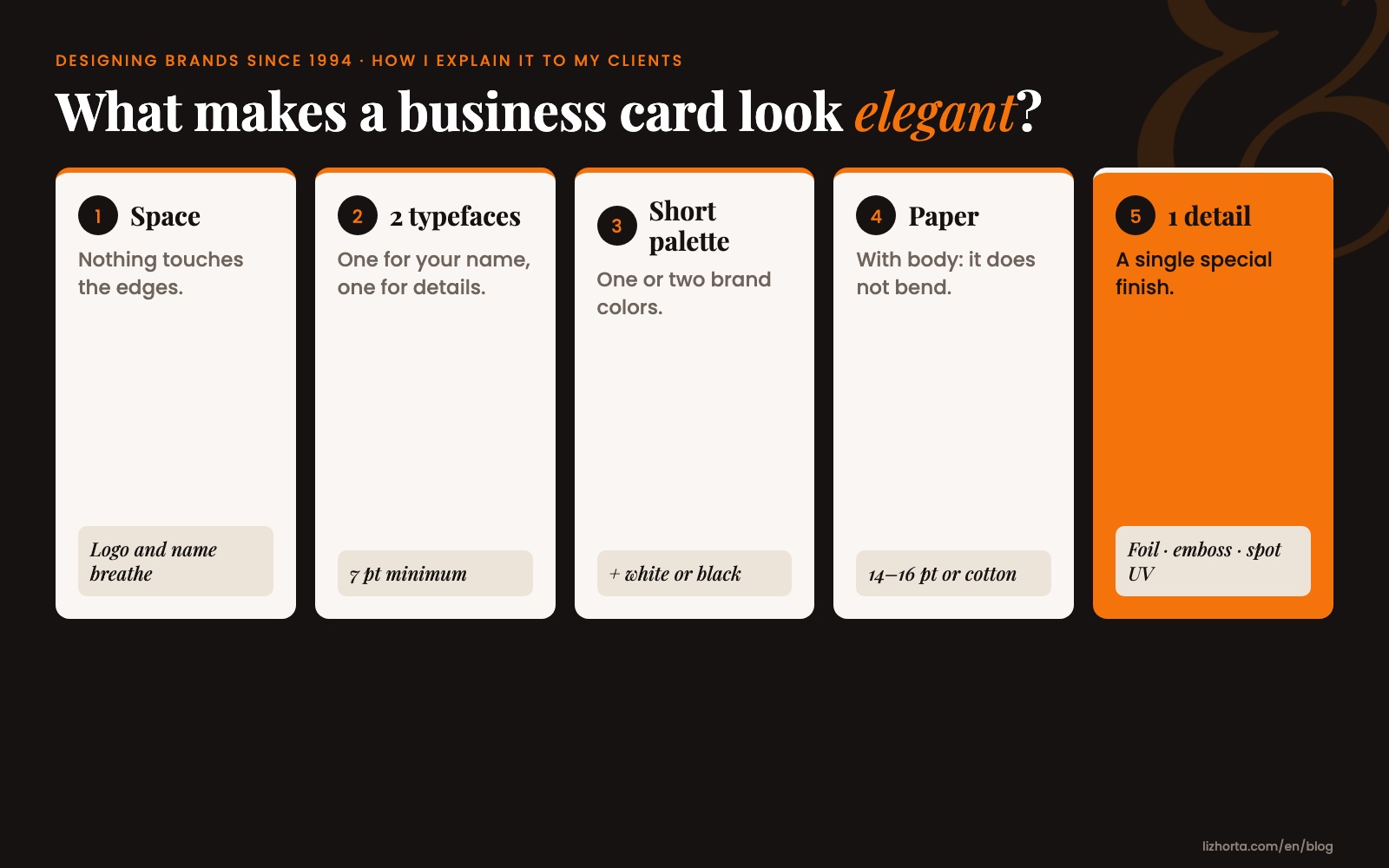
Elegance does not come from adding things, but from taking them away. Cards that look expensive almost always share five traits:
- Plenty of white space. The logo and your name breathe; nothing touches the edges.
- One or two typefaces at most. One for your name and one for the details, in clear sizes.
- A short palette. One or two brand colors, plus white or black.
- Paper with body. When you hold it, the card does not bend.
- A single special detail. One finish, a colored edge or an emboss, not all of them at once.
In the stationery I have designed for professional services firms, the special detail is usually the brand symbol used as a watermark on the back, or a metallic color on the logo. That is enough.
What size is a business card?
In the United States the standard is 3.5 × 2 inches (8.9 × 5.1 cm). In Mexico the most common size is 9 × 5 cm, and in much of Europe it is 85 × 55 mm.
To send it to print, the file needs:
- 1/8 inch (3 mm) of bleed on each side (the area that gets trimmed).
- A safe margin of about 1/8 to 3/16 inch (4–5 mm) inside the edge: no important text goes there.
- Text of at least 7 points so it can be read without glasses.
- Colors in CMYK (or Pantone, if your brand guidelines say so) at 300 dpi.
Which paper and finishes should you choose?
- Coated stock, 14–16 pt (300–350 gsm): smooth and firm. The safe choice for almost anything.
- Cotton or textured paper: warm, handcrafted. Great for law firms, architects and personal brands.
- Matte lamination: soft, no glare. For dark cards or cards with photos.
- Spot UV: gloss only on the logo, to highlight one element.
- Foil stamping: metallic gold or silver. For luxury brands or premium services.
- Embossing or letterpress: you feel it; it makes the card memorable.
My advice: pick one good paper and one finish. If you combine lamination, foil, emboss and painted edges, the card looks overloaded and costs more than it communicates.
What information should a business card include?
- Your name and your title or specialty (not just "Director": better "Construction law" or "Residential architecture").
- One phone number (ideally the one with WhatsApp) and one email on your own domain.
- Your website or the network where people actually look you up (for professionals, usually LinkedIn).
- Your logo and, if relevant, your office address.
Less is more: with three phone numbers and five social networks, nobody knows how to reach you. Everything else can live on the digital version.
Printed or digital business card: which is better?
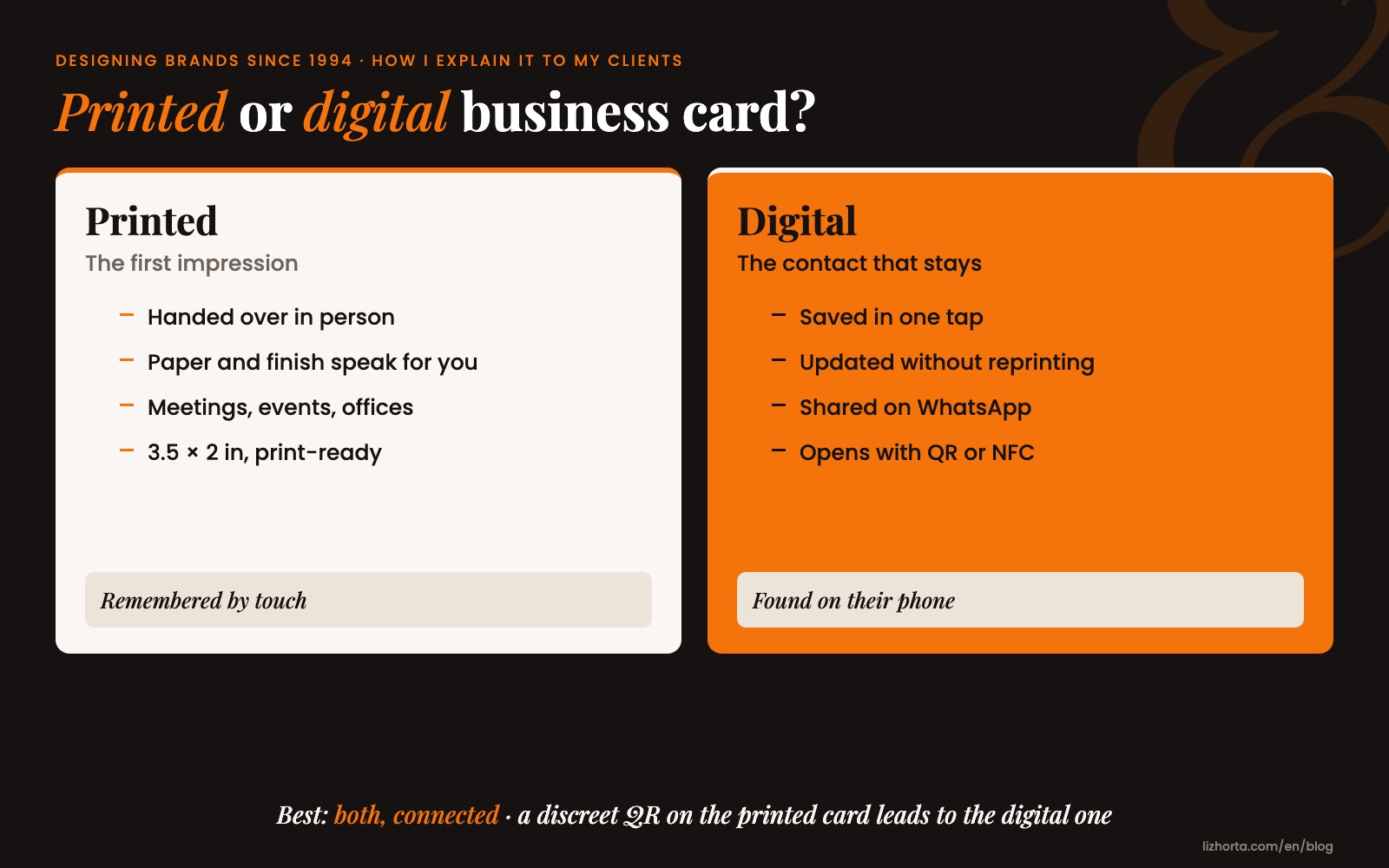
Both, connected. Printed cards still work in meetings, events and offices, because handing one over is part of professional courtesy. A digital card solves what paper cannot: it saves to a phone in one tap, updates without reprinting and can be shared on WhatsApp.
The formula I use most with clients is an elegant printed card with a discreet QR code on the back that leads to their digital card. Paper makes the first impression and the phone keeps the contact.
What is a digital NFC Business Card and why are more people using it?
It is the modern version of the business card: a card or badge with an NFC chip that opens your digital card the moment you tap it on someone's phone. No app, no scanning; the phone reads it on its own. For phones that do not read NFC, the same card carries a QR code.
What opens is a page with your photo, your details and direct buttons:
- "Save contact": your full vCard goes into their phone's contacts, photo included.
- WhatsApp, call, email and website in one tap.
- Share: they can forward your card to whoever needs it.
- Contact form: someone you meet at an event can leave their details so you can follow up.
Why is it replacing paper?
- It never runs out. One card works for every meeting.
- It updates without reprinting. New phone, title or website? Change the page and the card keeps working.
- People actually keep it. Instead of ending up in a drawer, your contact lives on their phone.
- You know it works. With the analytics plan you see how many times your card was opened and how many people saved your contact or messaged you.
- For companies, the whole team looks the same. Every employee gets a card with the same identity, and the company controls the details.
I design them at bcard.lat with each brand's palette, typography and logo, so the digital card looks as polished as the printed one. You can have it as an NFC badge, as a printed card with a QR code or digital only, and for companies we set up cards for the whole team.
Discover digital Business Cards
Business cards for lawyers, doctors or architects: what changes?
The structure is the same; the tone changes. A law firm usually asks for restraint (navy, gray, a matte finish); an architect, a textured paper and lots of space; a doctor or therapist, clarity about hours and how to book. In every case the rule is the same: the card should look like the rest of your brand, from your email signature to your website.
If your identity is not defined yet, start there: I explain how in Personal branding for professionals: where to start?
What are some famous business card examples?
- Goethe's visiting card. In the 19th century an elegant card carried only the name, with no address or ornament: early proof that less is more. See the history of business cards
- The meishi in Japan. The card is given and received with both hands and read before it is put away: it is part of business etiquette, which is why its design is taken so seriously. See the meishi
Once you have your card, make sure your colors match everywhere: How to choose your brand colors
Want business cards that look like your brand?
CTA.
Frequently asked questions about business cards
What is the standard business card size?
In the US it is 3.5 × 2 inches (8.9 × 5.1 cm); in Mexico, 9 × 5 cm; in much of Europe, 85 × 55 mm. Add 1/8 inch (3 mm) of bleed on each side for printing.
What paper is used for elegant business cards?
A 14–16 pt coated stock is the safe choice; cotton or textured paper feels more handcrafted. Pair it with a single finish, such as matte lamination or foil on the logo.
What is a digital business card?
A page with your photo, your details and a button to save your contact on a phone. It opens with a QR code or by tapping an NFC chip card, and it updates without reprinting.
What is an NFC Business Card?
A card or badge with a chip that, when tapped on a phone, opens your digital card with a button to save your contact, plus WhatsApp, email and website. No app needed, and it updates without reprinting.
Is a printed or a digital business card better?
Ideally both, connected: an elegant printed card with a discreet QR code that leads to your digital card.
What should a business card include?
Name, title or specialty, one phone number, one email, your website or LinkedIn, and your logo. Everything else can go on the digital version.
Notes for Liz (not in the post)
- Same content as the Spanish version, with US sizes first.